Saturday, April 14, 2012

My quest for the perfect custom rifle

For many years I have pursued big game in Utah, Wyoming and New Mexico. I have purchased many rifles out of the box and had many more custom rifles built for me. I continued to be disappointed with their performance and mine behind them. It was good fortune to have guided with D'Arcy for several years in northern Utah and was intrigued by his approach to rifle building. After many years and thousands of dollars spent on rifles that I could not shoot well I finally ordered a 300 Weatherby Legend Long Range from D'Arcy.

My expectations have been met and exceeded. The proof is in the pudding applies here. I have supplied some of the results of my experience with what I believe is the most reliable rifle built on the earth today. If you are on the fence in regard to purchasing an Echols rifle, jump off the fence and get behind the Ferrari of rifles. My proficiency, accuracy and confidence has been astounding with this firearm. I have used this rifle from as close as 30 yards to 625 yards with an average distance to the intended target of 390 yards.

R. Pepper Murray, MD


Sunday, March 18, 2012

Mark travels to Utah

I met Mark at the SCI convention this year in Las Vegas. He was shopping for a custom rifle and from what he said he had visited every custom rifle builder in the convention hall. At the end of our conversation I extended an invitation to visit our shop if ever he found the time and to come see what we do and shoot some of the rifles we had on hand.

He arrived last Sunday at 1pm and by 2pm we were at the range. He was contemplating acquiring a       7-mm Remington Magnum or a 300 Winchester Magnum and was now shooting both. First from the bench to confirm the zeros and compare the recoil and then from prone and then from a sitting position out to 300 yards. His last group of the day was a 1-1/8" three shot group at 300 yards fired from the bags with the 300 Win. I think he even surprised himself. The next day he arrived at the shop, took the grand tour and we were back at the range in short order. Brian introduced him to shooting with a sling both prone and sitting and then we hauled out Andy the Antelope and Mark went to town on Andy. His first group prone when into a 3" triangle  right where Andy's heart would lie.

 This type of interaction between a perspective client and the custom rifle maker allows the rifle maker to evaluate the client's shooting style and suggest changes when required and gain a more complete idea how the project should come together to better fulfill the shooter's ultimate needs. The prospective client can evaluate the maker to see if he thinks this union has even a prayer of working out. When you can travel to your rifle maker do so, as the benefits can far out way the expense in the long run for both parties involved.

Mark left northern Utah on a high note and we need to order another custom barrel.


When a good scope is going south

Recently we received 3 Legends to clean up and prepare for resale. All three rifles had been used on numerous Safaris as well a hunts in the western US. While used, non of the rifles showed any abuse. One of these Legends, a 7-mm Remington Magnum, did need to have the original scope removed and returned to the manufacture not to many years ago as the reticle had snapped at the duplex intersection. In due course the scope was returned from the repair department, re-mounted, re-zeroed and returned to the client.

As we now had a potential buyer for this particular rifle I had Matt completely dis-assembled and clean this 7-mm and per protocol he went to the range to zero the rifle before shipment to the prospective buyer. When he returned I was less than impressed with the size of the 3 shot groups he had just shot. I say this because I had done all the original shooting and load development for this rifle and had used this very rifle in Tanzania very effectively on wide variety of plains game. The ammunition Matt used was the same that had always been shot in this rifle. As we had all the construction and load data on file a quick look at the many targets from the past confirmed my suspicions that something was indeed amiss. This rifle with a select load and 175gr Partitions had historically turned out group after group in the .500 range with boring regularity. Having gone down this road more times than I care to remember I had Matt remove the clients scope and install our Leupold Mk-4 16X test scope on the rifle and head back to the range with the same loads.

It seemed we had a minor mechanical "issue" going on and I suspected the clients scope was the culprit. The results from this second trip to the range is shown in the enclosed pic.

Not being an optical engineer I can only speculate as to the cause. One could say that the 10X magnification limited Matt in precise bullet placement as compared to the 16X test scope. Maybe, But I do not think the extra 6X can equate to such a dramatic percentage in accuracy enhancement at 100 yards. Parallax? All the previous .500 groups were shot by myself with the very same 10X scope prior to the client receiving the rifle originally. If we didn't have a known history with this rifle we might except the groups shot with the original scope as typical for this rifle or that particular load. In reality 1.5"  three shot groups would be more than adequate for any hunting rifle. However since we knew the rifles background It was obvious there was now a weak link somewhere in the chain.

The modern hunting scope has advanced so much in the last 20 years that even Darwin would be impressed by the rate of evolutionary growth. What with click up turrets, range finding reticles, internal range finding lasers and illumination it's a wonder how optical companies can manage to cram all that stuff in that tube. We the consumer have demanded these innovations and the optic companies have given us what they think we need. It's a wonder how we ever managed to kill anything  in the past with those "obsolete" fixed powers.

What I have learned over the years is not all scopes are created equal even when assembled in the same plant. It matters little as to the manufacture or the retail cost. I am painfully aware that when a rifles typical accuracy mysteriously takes a dump the problem is more than likely due to a cave in the optical department and not the rifles construction or ammunition. It is cross we all have to bare and having a pre-zeroed spare scope in you're hunting kit is a really smart move. It can be a trip saver.

Having a test scope is always a good thing to have at your disposal, but finding a good one is sometimes a roll of the dice.


Tuesday, January 17, 2012

One rifle to rule them all...


I worked for D’Arcy while finishing up school at Utah State University.  At the time I had a Model 70 classic 30-06.  We began doing some improvements to it, adding the Legend Stock, when I asked D’Arcy about adding his magazine box and follower.  He said if we were going to do that we might as well make it into a full Legend Rifle.  Who could turn that down?

I’d become a fan of the 200 grain Nosler partition and decided the .300 Winchester Magnum would be a good platform to launch it from.  One of my goals was one rifle and one load that I could hunt almost anything with.

I spent much of my time in D’Arcy’s shop polishing metal work.  Polishing is tedious work that requires patience, attention to detail, and a commitment to do a good job.  It probably isn’t considered a glorious job, but good polishing is critical for the looks and function of the rifle.  It also taught me how to spot and feel the tiniest imperfections, because if I didn’t catch them D’Arcy would and he’d just send me back to my bench.  My project got thrown into the mix just like any of the others.  So along with the pride of owning a D’Arcy Echols & Company Legend I enjoy hunting with a rifle I had a hand in building.

My rifle was finished just before I moved to Wyoming.  I put a Leupold M8 6x36 on it and started hunting it.  During a guiding season in NW Wyoming I put a 1-4x Leupold on it for use as a bear gun.  When I re-mounted the 6x I didn’t have to touch the scope’s adjustments, it was still dead on.  After 8 years of use it’s continues to be a confidence inspiring rifle. 

In 2008 I killed what may be my best trophy, a 365” bull elk taken on the HD High Island Ranch where I live.  I first spotted the bull while looking over some young raghorns.  He had just come out of the tree line above a steep hill.  Once I got him in my glasses I knew he was big, his brow tines and whale tail just jumped out at me.  I literally ran down the hill I was on, headed towards a small finger ridge where I hoped the bull would be in range.  Once I got there I threw myself on the ground and ranged him at 328 yards.  I shot him twice as fast as I could and down he went.
 
The rifle has also taken several mule deer, a whitetail, and quite a few more elk as well.  It’s a pleasure to hunt with a rifle that I know inside and out and know will work every time.  

Bart Stam


Thursday, January 5, 2012

Side Lock Stock Machining: Part 3

With the demons removed from the blank I then place the blank and pattern back into the machine and cut the OD surface of the stock to what ever the client requests. Then I get set up to finish the inletting. Now I set up a rotary steady rest to virtually eliminate the vibration and flex from both the pressure I apply to the pattern with the stylus and my hand and the vibration generated by the cutter on the stock being cut. A dial indicator is used to zero the pattern and stock in the rotary rest. The rest lends rigidity to the procedure that allows you to cut the inletting very, very accurately.

As this machine will allow the operator to cut in 5 axis draft angles and radiuses following the glass bedded inletting footprint is no problem. The excess wood is removed from the inletting by using a progressively smaller diameter stylus until the cutter and stylus are matched quite literally 1to1 if so desired. Different thickness's of shim stock under the tip of the stylus regulate the depth of the cutters path.

If the machine used is accurate, if the barreled action is accurately glass bedded into the pattern, if a series of styluses are made to match each cutter +.001 to +.002 larger than the cutter, if the rotary rest is used on both the pattern and stock, the operator doesn't have a coffee buzz on and if the phone is unplugged the results can be pretty damn impressive. Thus saving time on inletting and shaping that can devoted elsewhere on the project.


Side Lock Stock Machining: Part 2

The oversized stock is then left to stress relieve for a couple days. For the purpose of this blog posting I set the machined stock on one of our surface plates and zeroed an indicator stem on the top side of the stocks grip and left for the evening. Overnight the indicator shows that the blank has moved .009 laterally. In short the blank has in fact moved or stress relieved itself. Now .009 is nothing to worry about and we have left plenty of extra wood on the OD surface and in the ID of inletting.  I have seen shotgun blanks such as this one and full length rifle blanks move as much as an 1/8th of an inch or more in every direction. I think being able to rough machine a blank and allow it to do the mambo before I begin to inlet it has some real advantages, others will disagree, to each his own. Some of the least stable wood I ever cut was turkish being imported and sold to the trade in the mid 80's.  I often thought it would sprout leaves and bear nuts when I entered the shop the next morning.

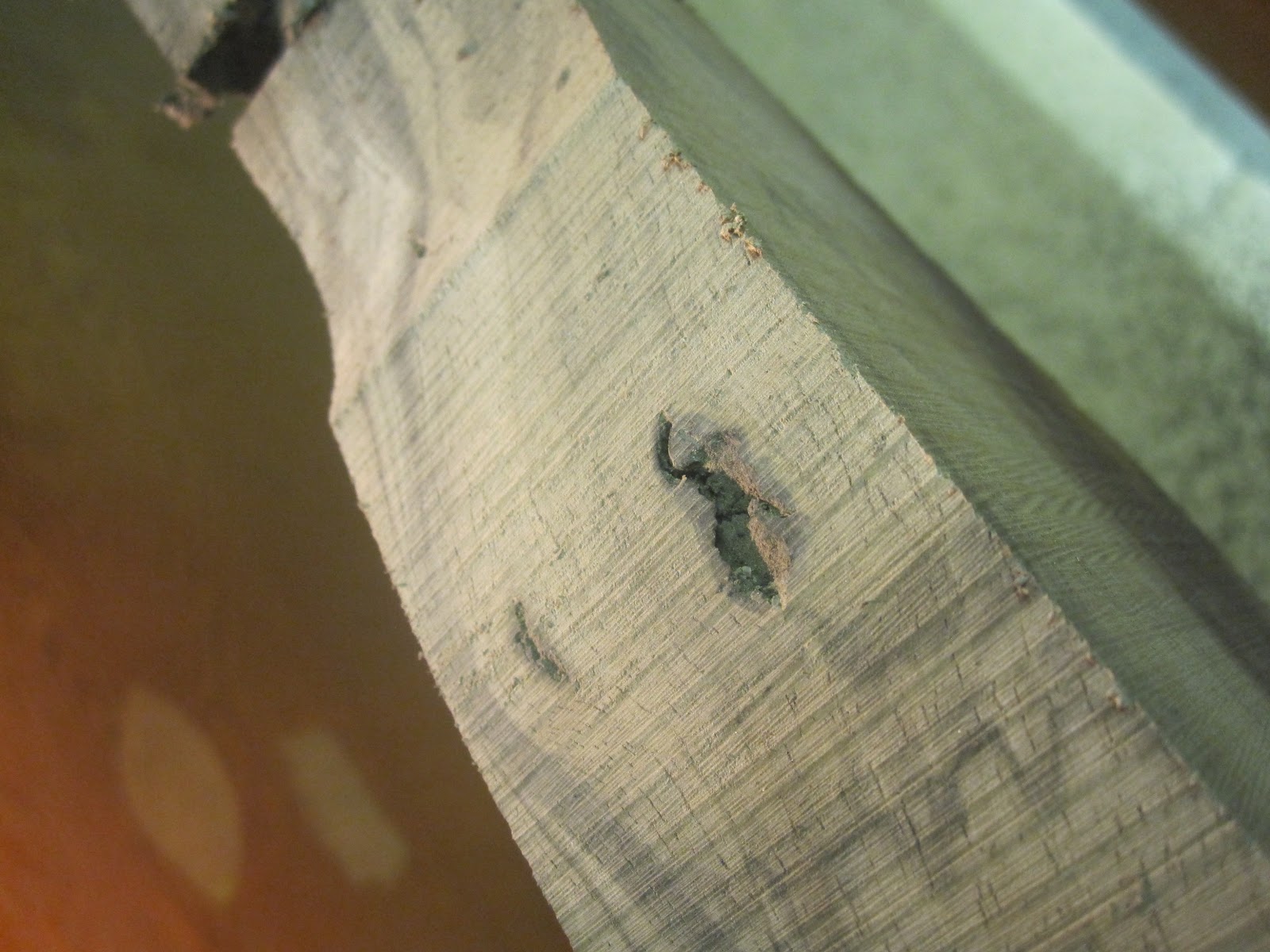
Another advantage to machining a blank versus building one from a blank is being able to find voids, checks, barbed wire and bullets buried within the blank that are not visible when the blank is un-profiled. While most blanks are x-rayed to find any metal buried in a blank to save saw blades at the mill they don't always catch them. The blank in this blog shows a perfect example of a void that was not visible on the exterior of the blank. I have found bark pockets and voids large enough to house a raccoon in some very expensive blanks way under the surface. At least when an internal blemish is found little precious labor is lost and an assessment of the problem can be addressed early in the game.


Side Lock Stock Machining: Part 1

Recently I machined a side lock butt stock for a client in the UK. The client had glass bedded the inletting where necessary to eliminate any voids or imperfections that the stylus could drop into and create a duplicate gap in the newly machined stock. This original stock was unusual as it came with a Selous brass stock plate that was applied at some point to repair a break in the grip at one time. I left the plate in place and worked around it.

As the stock to be cut needed to have a 1" LOP extension, the length of the pattern was extended to allow the longer LOP. Both stocks were loaded between the centers and using an oversized stylus and undersized cutter I cut the profile of the pattern into the french walnut blank. I then trimmed the x & y profile with the band saw and then returned the french blank to the machine and cut a series of 360 degree groves around circumference of the french blank from end to end. The grooves are cut leaving + 1/4 " extra wood over the OD of the pattern stock. I then trim off the excess material from the french blank with the band saw again. I then remove the majority of the exterior walnut and end up with an oversized stock that duplicates the pattern's shape.

Once the OD of the stock is profiled oversized I cut in the basic side lock, action and trigger plate cavities. This is done with a stylus and cutter that will allow me plenty of wood in the action area. The stock and pattern are then removed from the machine.